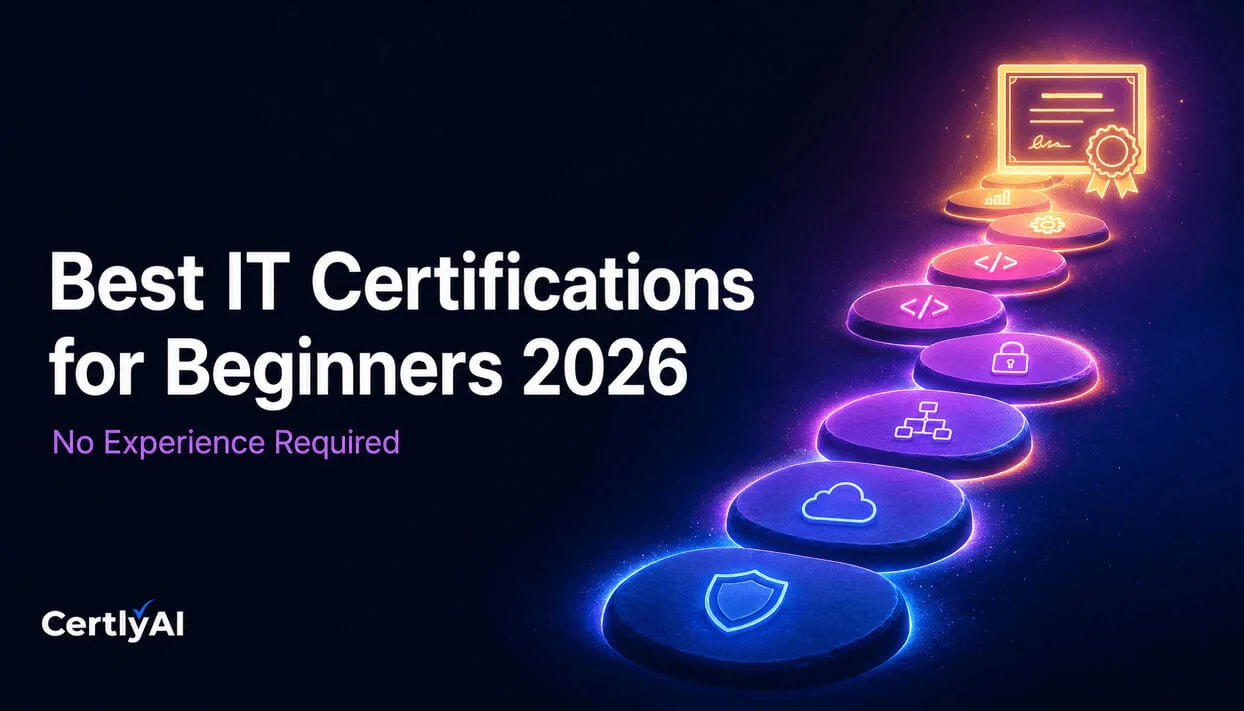
Starting a career in IT has never been more accessible — and the right certification can open doors even if you have zero professional experience. Whether you're switching careers, just graduated, or simply curious about tech, the best IT certifications for beginners give you a structured path to your first job in the industry.
This guide covers the top entry-level IT certifications in 2026, what each one leads to, how hard they are, and which one you should probably start with.
TL;DR: CompTIA A+ is the classic starting point for IT support. CompTIA Security+ and AWS Cloud Practitioner are strong alternatives if you want to head toward cybersecurity or cloud. All six certs on this list require no prior experience to sit the exam.
Can You Actually Get an IT Job With Just a Certification?
Yes — and this is more true in 2026 than it has ever been. Employers in IT support, cloud operations, and cybersecurity have increasingly dropped the four-year degree requirement, replacing it with demonstrable skills validated by certifications.
That said, a certification alone won't do all the work. The candidates who land jobs combine their cert with a home lab, a GitHub repo, or a small portfolio project. Think of the certification as proof of knowledge, and the portfolio as proof of application.
The certs on this list are all exam-based (no prerequisite certifications required), vendor-neutral or vendor-entry-level, and recognized by employers globally.
The 6 Best IT Certifications for Beginners in 2026
1. CompTIA A+ — The IT Support Foundation
Exam codes: Core 1 (220-1101) and Core 2 (220-1102)
Cost: $253 per exam ($506 total)
Study time: 6–12 weeks (2–3 hours/day)
CompTIA A+ is the most recognized entry-level IT certification in the world. It covers hardware, operating systems, networking basics, troubleshooting, and security fundamentals across two exams. Most IT support roles — help desk, desktop support, field technician — list A+ as either required or preferred.
What jobs does it lead to?
- IT Support Specialist
- Help Desk Technician
- Desktop Support Analyst
- Field Service Technician
Salary snapshot: A+ holders in the US typically start at $40,000–$52,000/year. With 2–3 years of experience, that range moves to $55,000–$70,000.
Is it hard? It's approachable, but not a pushover. The Core 1 exam leans on hardware and networking; Core 2 focuses on OS and security. You'll face performance-based questions (simulations) alongside multiple choice, so you need hands-on practice, not just memorization.
2. CompTIA Network+ — Networking Fundamentals
Exam code: N10-009 Cost: ~$358 Study time: 8–12 weeks
If you want to move into networking, cloud infrastructure, or systems administration, Network+ is your foundation. It covers TCP/IP, routing and switching, wireless, network security, and troubleshooting. It pairs well with A+ but can be taken independently.
What jobs does it lead to?
- Network Technician
- Network Administrator (junior)
- Systems Administrator (entry)
- NOC Analyst
Salary snapshot: Network+ certified professionals earn $52,000–$68,000 at the entry level. Network administrators with the cert and experience average $75,000–$90,000.
Is it hard? Network+ assumes you understand what a network is. If you're coming in completely fresh, spend a week on TCP/IP basics before diving in. Tools like Wireshark and Cisco Packet Tracer (free) are your friends during prep.
3. CompTIA Security+ — The Cybersecurity Entry Point
Exam code: SY0-701 Cost: ~$392 Study time: 8–12 weeks
Security+ is arguably the most valuable certification on this list dollar-for-dollar. It's approved under DoD Directive 8140/8570, which means it's required (not just preferred) for thousands of US government and defense contractor roles. Even outside government work, cybersecurity job postings reference Security+ more than any other entry-level cert.
What jobs does it lead to?
- Cybersecurity Analyst (junior)
- SOC Analyst Tier 1
- Security Administrator
- IT Auditor
- Government/defense contractor security roles
Salary snapshot: Security+ holders start at $58,000–$72,000. SOC analysts with Security+ in government contracting frequently earn $75,000–$95,000 even at entry level.
Is it hard? More conceptually demanding than A+ or Network+. The SY0-701 exam includes performance-based questions on things like analyzing logs, configuring firewalls, and identifying attack vectors. Platforms like CertlyAI offer adaptive practice tests that simulate the exam environment closely, which is especially useful for Security+ because the question style is notoriously tricky.
4. AWS Certified Cloud Practitioner — Cloud Fundamentals
Exam code: CLF-C02 Cost: ~$100 Study time: 4–6 weeks
Cloud Practitioner is AWS's entry-level certification and the cheapest exam on this list. It doesn't make you a cloud engineer, but it gives you a working vocabulary of AWS services, cloud concepts, pricing, and the shared responsibility model. It's ideal if you're aiming for cloud-adjacent roles or want to add cloud literacy to a non-technical role.
What jobs does it lead to?
- Cloud Support Associate
- Solutions Architect (pathway — this cert is the first step)
- Cloud Sales/Pre-sales
- Technical Account Manager
- IT roles at AWS-heavy organizations
Salary snapshot: Cloud Practitioner alone typically adds $5,000–$10,000 to a base salary or helps break into cloud roles starting at $60,000–$75,000. Most candidates use it as a stepping stone to AWS Solutions Architect Associate (SAA-C03).
Is it hard? It's the most accessible exam on this list. With 4–6 weeks of studying and a handful of practice tests, most people pass on the first attempt. The challenge is understanding the why behind AWS services, not just memorizing names.
5. Microsoft Azure Fundamentals (AZ-900) — Microsoft Cloud Entry
Exam code: AZ-900 Cost: ~$165 Study time: 2–4 weeks
AZ-900 is Microsoft's equivalent of AWS Cloud Practitioner — a foundational cloud certification covering Azure services, cloud concepts, compliance, pricing, and SLAs. If you work in a Microsoft-heavy organization (Office 365, Active Directory, Windows Server), AZ-900 is a natural fit and a smart first step toward AZ-104 (Azure Administrator).
What jobs does it lead to?
- Azure Support Roles
- Cloud Administrator (pathway)
- IT roles at Microsoft-stack companies
- Technical Sales/Pre-sales for Microsoft products
Salary snapshot: AZ-900 holders entering Azure administrator tracks typically see salaries of $65,000–$80,000 within 12–18 months of the certification, especially after adding AZ-104.
Is it hard? AZ-900 is widely considered one of the easiest IT certifications available. Two to four weeks of study is realistic for someone with no cloud background. It's a low-risk, high-signal way to prove you understand cloud fundamentals to any employer.
6. Google Cloud Digital Leader (CDL) — GCP Fundamentals
Exam code: Cloud Digital Leader Cost: ~$200 Study time: 4–6 weeks
Google Cloud Digital Leader is GCP's entry-level credential, aimed at both technical and non-technical roles. It covers Google Cloud products, digital transformation concepts, and how organizations use cloud to solve business problems. It's broader than AWS Cloud Practitioner in scope (includes business strategy topics), which makes it slightly more accessible to people coming from non-technical backgrounds.
What jobs does it lead to?
- Cloud Solutions roles at Google Cloud partners
- IT roles at GCP-heavy organizations
- Business analyst or product roles at tech companies
- Technical Account Manager
Salary snapshot: CDL itself is a foundational cert, so the salary impact is modest at the entry level ($55,000–$70,000 for cloud support roles). Its real value is as a launchpad toward the Associate Cloud Engineer (ACE) or other GCP professional certs.
Is it hard? Similar difficulty to AZ-900. The business strategy component catches some purely technical people off guard, but it's manageable with 4–6 weeks of study.
Side-by-Side Comparison
| Certification | Cost | Study Time | Difficulty | Starting Salary Range | Best For |
|---|---|---|---|---|---|
| CompTIA A+ | ~$506 | 6–12 wks | Moderate | $40K–$52K | IT support, help desk |
| CompTIA Network+ | ~$358 | 8–12 wks | Moderate | $52K–$68K | Networking, sysadmin |
| CompTIA Security+ | ~$392 | 8–12 wks | Moderate-Hard | $58K–$72K | Cybersecurity, gov roles |
| AWS Cloud Practitioner | ~$100 | 4–6 wks | Easy-Moderate | $60K–$75K | Cloud entry, AWS pathway |
| AZ-900 | ~$165 | 2–4 wks | Easy | $65K–$80K (with AZ-104) | Microsoft cloud entry |
| Google Cloud CDL | ~$200 | 4–6 wks | Easy-Moderate | $55K–$70K | GCP entry, non-technical |
Which Certification Should You Start With?
If you want to work in IT support: Start with CompTIA A+.
If you're drawn to networking or systems: A+ first, then Network+.
If cybersecurity interests you: Security+ can be taken without A+ or Network+, but having some IT fundamentals first helps.
If you want to go into cloud: AWS Cloud Practitioner or AZ-900 depending on whether your target employers run AWS or Azure. AZ-900 is the easiest on the list if you just want to get something on your resume quickly.
If you're not sure: AZ-900 is the lowest-risk starting point — cheap, fast, and recognized everywhere.
How to Study Without Work Experience
- Use free cloud tiers. AWS, Azure, and GCP all offer free tiers with real service access. Spin up a virtual machine. Create an S3 bucket. Explore the console.
- Build a home lab. Even a $40 Raspberry Pi or old laptops can run network experiments for A+ and Network+.
- Take practice tests early and often. Don't save practice tests for the final week. Take a diagnostic test in week one to identify gaps, then revisit throughout. CertlyAI offers adaptive practice tests for all six certs on this list, with detailed explanations for every answer.
- Follow a structured course. Professor Messer (free) for CompTIA, Adrian Cantrill or Andrew Brown for AWS, John Savill for Azure. Pair with practice tests and you have a complete study system.
FAQ
Q: Can I get an IT job with just a certification and no experience? Yes, especially for help desk and IT support roles. Pair your cert with a home lab or personal project to strengthen your application.
Q: Which IT certification is easiest to get? AZ-900 (Azure Fundamentals) — most candidates pass after 2–4 weeks of study.
Q: Do CompTIA certifications expire? Yes. A+, Network+, and Security+ are valid for three years, renewed via continuing education credits or a higher-level exam.
Q: Is AWS Cloud Practitioner worth it, or should I skip to Solutions Architect? Worth it if you're new to cloud. It's cheap ($100), fast to prep for, and makes the SAA-C03 exam significantly easier.
Q: Which certification has the best ROI for a career changer? CompTIA Security+, primarily because DoD 8140 compliance creates consistent demand for Security+-certified professionals in government and defense roles where salaries are above average even at entry level.
Q: How long does it take to get a job after getting certified? Most candidates who combine a certification with hands-on practice land their first IT role within 2–4 months.
Start Practicing Today
The gap between studying and passing is almost always practice test volume — not more reading. CertlyAI offers free practice tests for all six certifications covered in this guide, with AI-powered explanations and a readiness score that tells you whether you're actually ready to schedule your exam.
Ready to check your readiness? Take a free IT certification practice test on CertlyAI →
Ready For The Next Step?
Stop watching courses. Start passing with real exam practice.
Use exam-style practice and readiness scoring to close weak areas faster.