AWS SAA-C03 Practice Questions and Answers (2026)
Stop watching courses. Start passing with real exam practice.
This page is built for one outcome: better architecture decisions under exam pressure.
If you only read explanations and never test tradeoffs, your score will plateau.
Quick Answer Block
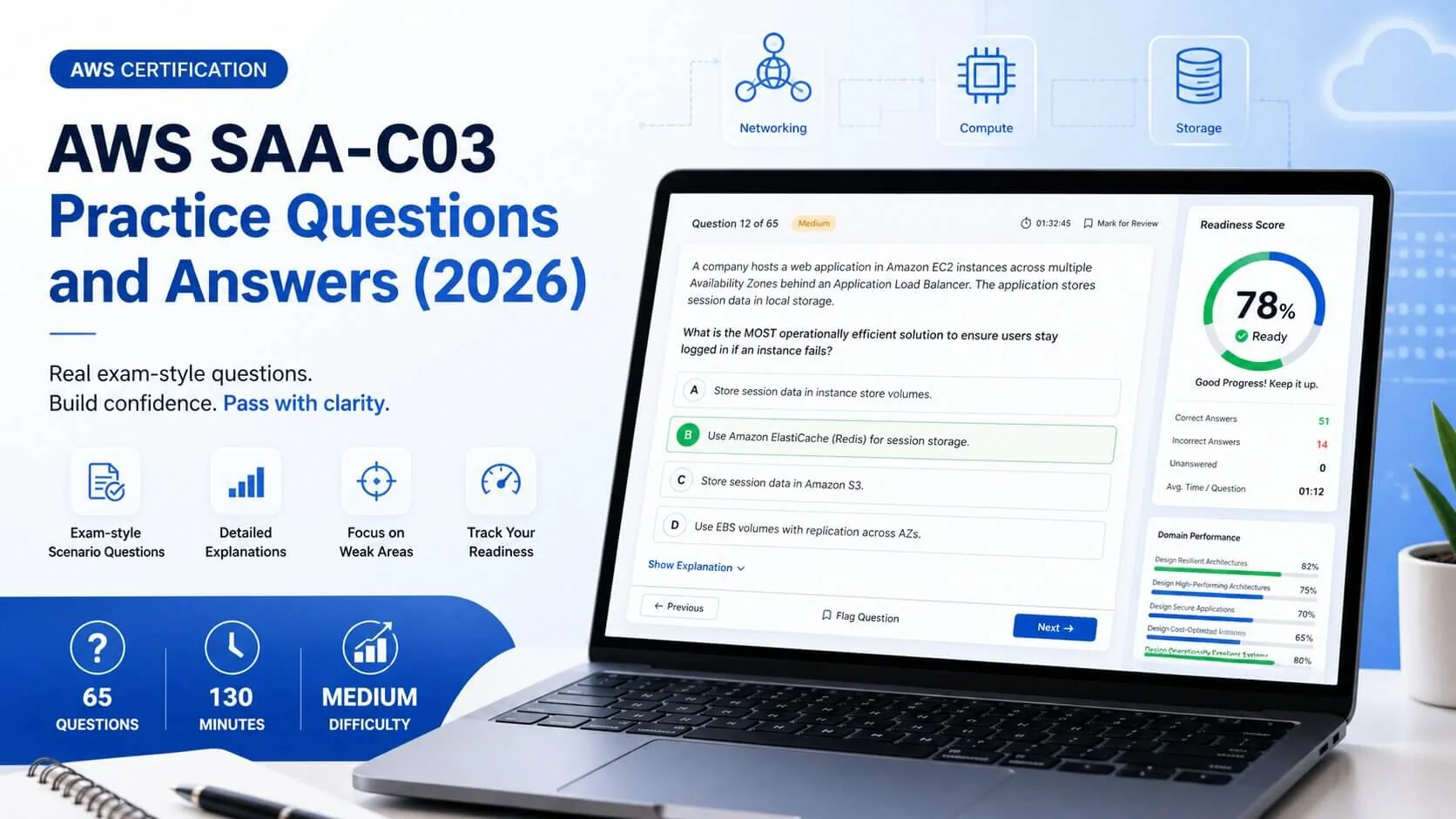
- Questions in exam: 65
- Duration: 130 minutes
- Passing zone (scaled): commonly treated around 720/1000
- Difficulty: Medium, but scenario-heavy and trap-prone
How to Use This Page Like a Top Scorer
Use this sequence on every question:
- Read the business requirement first.
- Identify the primary constraint: cost, security, latency, resilience, or operations.
- Eliminate technically possible but operationally weak options.
- Pick the best tradeoff, not the fanciest architecture.
- Log your mistake pattern before moving to the next question.
Most candidates skip step 5. That is why they repeat the same errors.
Question 1: VPC Networking
A workload in private subnets must access S3 without traversing the public internet. What is the best approach?
- A. NAT Gateway + Internet Gateway
- B. VPC Endpoint for S3
- C. Public subnet EC2 proxy
- D. Transit Gateway only
Correct answer: B
Why B is correct:
- Keeps traffic on AWS backbone.
- Reduces NAT dependency and often lowers cost.
- Aligns directly with private access requirement.
Why others are weaker:
- A: Works, but adds unnecessary internet path dependency for S3 access.
- C: Adds custom ops burden and avoidable complexity.
- D: Not sufficient by itself for private S3 access.
Exam pattern insight:
Many candidates pick A because it feels familiar. AWS expects the most direct managed option.
Question 2: High Availability on EC2
You need a web tier to survive instance failure across AZs with minimal manual operations.
- A. Single EC2 with bigger instance type
- B. Multi-AZ Auto Scaling Group behind ALB
- C. Spot-only single AZ fleet
- D. RDS read replica for web traffic
Correct answer: B
Why B is correct:
- Delivers HA across AZs.
- Automatically replaces unhealthy instances.
- Balances traffic and supports elastic scaling.
Why others are weaker:
- A: Bigger instance does not remove single point of failure.
- C: Single AZ and spot interruption risk make resilience weak.
- D: RDS read replicas are irrelevant to web-tier availability.
Most people get this wrong because:
They optimize compute size before failure-domain design.
Question 3: Cost Optimization for Storage
Large objects are rarely accessed after 90 days. Which is best?
- A. Keep all objects in S3 Standard forever
- B. S3 lifecycle to Standard-IA/Glacier tiers
- C. Move objects to EBS snapshots
- D. Keep on EC2 instance store
Correct answer: B
Why B is correct:
- Policy-based automation of storage transitions.
- Strong long-term cost efficiency for cold data.
- Minimal operations overhead.
Why others are weaker:
- A: Simple but expensive for low-access workloads.
- C: EBS snapshots are not a primary archival pattern for this use case.
- D: Instance store is ephemeral and operationally risky.
Question 4: Security for App Credentials
An application on EC2 needs database credentials rotation without hardcoding secrets.
- A. Store in user data
- B. Use AWS Secrets Manager + IAM role
- C. Put in AMI tags
- D. Embed in code repo
Correct answer: B
Why B is correct:
- Centralized managed secret lifecycle.
- Rotation support.
- Least-privilege access using instance role.
Why others are weaker:
- A: User data exposure and poor secret hygiene.
- C: Tags are not a secure secret store.
- D: Hardcoded secrets create audit and breach risk.
Question 5: Performance for Global Static Content
Users worldwide report high latency for static assets. What should you implement first?
- A. Bigger EC2 size
- B. CloudFront distribution in front of S3
- C. More NAT gateways
- D. Increase RDS IOPS
Correct answer: B
Why B is correct:
- Edge caching reduces global latency fast.
- Offloads origin and improves user experience.
- Directly addresses static content delivery pain.
Why others are weaker:
- A: Compute scaling does not fix global content distance.
- C: NAT gateways are unrelated to static asset acceleration.
- D: Database IOPS does not solve CDN latency issues.
If You Are Scoring 50-65%, Do This Next
- Prioritize VPC, IAM, and S3 scenario sets first.
- Switch from untimed to timed blocks immediately.
- Review wrong options, not only correct answers.
- Retake weak-topic questions within 24 hours.
If you are already scoring above 70%, shift to full-length timed mocks and pace control.
Mini Diagnostic (3 Questions)
Try this before moving to a full mock:
- A workload needs private access to DynamoDB from private subnets. What pattern is usually best first?
- A business needs HA with minimal operations. Which matters first: bigger instance or multi-AZ design?
- A secure app needs temporary AWS API access. What should you avoid: IAM role or static keys in code?
Write your answers before checking below.
<details> <summary><strong>Reveal Mini Diagnostic Answer Logic</strong></summary>- Prefer managed private endpoint patterns over internet-routed workarounds where applicable.
- Multi-AZ resilience pattern first. Instance size is secondary.
- Avoid static keys in code. Prefer IAM role-based temporary credentials.
Final Exam Mindset
SAA-C03 is not a memory contest. It is a tradeoff exam.
When two options look correct, choose the one that:
- matches the business requirement most directly,
- reduces operations burden,
- preserves security and resilience by default.
SAA-C03-Q1
A multi-tier web platform has latency spikes during peak traffic while the team is targeting resilient architecture.
What should the solutions architect do first?
SAA-C03-Q2
Sensitive data in a multi-tier web platform must be protected while still enabling analytics under performance optimization requirements.
Which control should be enforced first?
Want full test experience?
Start a timed mock and get a full readiness breakdown.
Start SAA-C03 Mock TestSAA-C03-Q3
A release failure happened because deployment permissions were overly broad, impacting cost-aware design.
What is the strongest remediation?
SAA-C03-Q4
Costs rose sharply after traffic growth in a multi-tier web platform, threatening cost-aware design outcomes.
What should be reviewed first?
Want full test experience?
Start a timed mock and get a full readiness breakdown.
Start SAA-C03 Mock TestSAA-C03-Q5
Multiple teams use inconsistent controls across accounts in a multi-tier web platform, weakening performance optimization.
What should leadership implement first?
SAA-C03-Q6
The business demands strict recovery targets for a multi-tier web platform to meet resilient architecture.
Which approach aligns best?
Want full test experience?
Start a timed mock and get a full readiness breakdown.
Start SAA-C03 Mock TestSAA-C03-Q7
Security findings show recurring misconfigurations in the multi-tier web platform and impact performance optimization.
What should the team do first?
SAA-C03-Q8
A modernization initiative lacks clear ownership and operating standards for resilient architecture.
What should the solutions architect lead do first?
Want full test experience?
Start a timed mock and get a full readiness breakdown.
Start SAA-C03 Mock TestSAA-C03-Q9
The platform team needs better release confidence before peak season and must satisfy cost-aware design.
Which action provides the most reliable improvement?
SAA-C03-Q10
Executives request readiness proof for a major platform milestone mapped to resilient architecture, performance optimization, and cost-aware design.
What reporting model is strongest?
Ready For The Next Step?
Stop watching courses. Start passing with real exam practice.
Use exam-style practice and readiness scoring to close weak areas faster.